
AN ENCYCLOPEDIA IS A RETENTION PROBLEM
In 2014 I spent a lot of words on this blog arguing that founders count the wrong number. Everyone counted new users. I kept saying: count the ones who come back. Acquisition without retention is a bucket with a hole in it, and only the sum of the two tells you whether a project is alive.
Eleven years later I am running a project with no funding round ahead of it, no exit, and no users in the venture sense at all. It is an encyclopedia. And the first thing I did when I restarted it was to throw away the obvious metric and pick a retention one instead.
The project
I started the Encyclopedia of Nizhny Novgorod in 2009, in the city where I grew up and built my first internet businesses. The first articles went up on 26 August 2009. Then life happened — other startups, another country — and the wiki went quiet with about two thousand articles on it, most of them written by a handful of local enthusiasts.
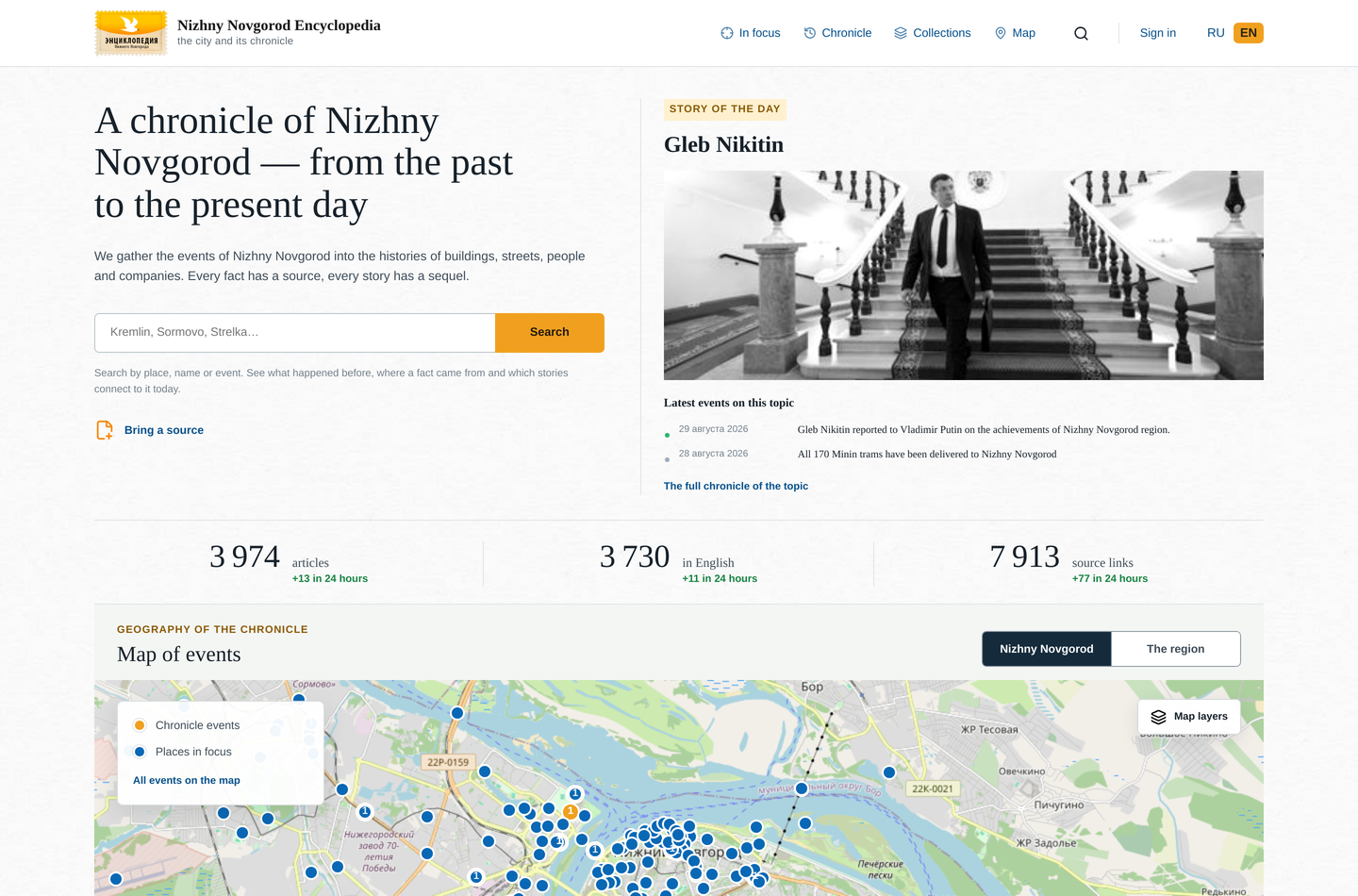
In 2026 I rebuilt it from the ground up: a new engine, a new design, a daily chronicle of city events, an interactive map, full-text search, and a parallel English edition covering nearly every article. It now holds close to four thousand articles and about eight thousand source links. It lives at www.nnov.ec, and it is in public beta.
The wrong metric
The obvious metric for an encyclopedia is articles published per day. Everybody reports it, and it is worthless. Publishing an article is acquisition. An article written once and never touched again is a page in an archive, and archives are a solved problem.
What an encyclopedia can do that no archive and no newsroom can is accumulate. A cable car opens. Two years later a cabin stops mid‑span. The line closes. Repairs are announced, then postponed. It reopens with a new fare. In a media archive that is five unrelated publications, three of which already return 404. In an encyclopedia it is one object with a history, and the history is the product.
So the number I actually track is the share of articles that get a second entry. As I write this, 744 articles have been extended after they were created, and 530 of them — seventy‑one percent — have been extended more than once. That is the retention curve of the project. If it flattens, I am writing an archive again.
How it runs
Every day the engine reads the local press, decides which events belong in the city chronicle, marks up the people, buildings and companies mentioned in them, and then either creates an article for an object or adds one line to the article that already exists. A line, not a retelling: the story of the event lives in the article about the event, and the object gets a date, a sentence, a link and a footnote. Otherwise an object slowly drowns in five versions of the same paragraph.
Every fact carries a source, and every source is archived, because a link to a regional news site has roughly the half‑life of a mayfly. And nothing happens silently: every change to every article — creation, edit, rename, merge, a moderator's decision — is written to a journal, 92,028 entries so far. That journal is not decoration. It is what answers "where did this sentence come from" a year later, and it is what rebuilds the site's redirects.
The dead internet of one city
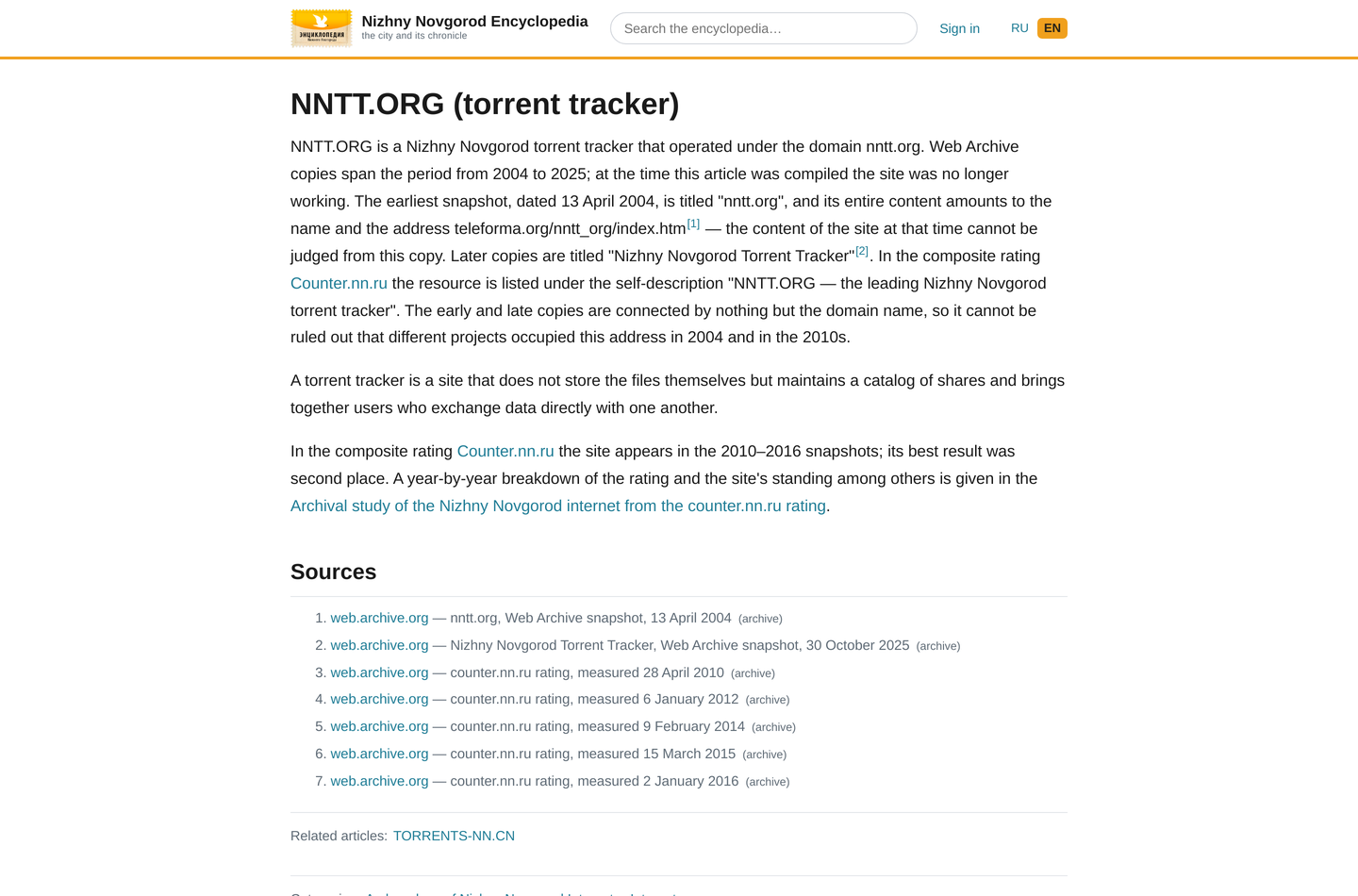
Along the way the project grew a section I never planned. In the 2000s Nizhny Novgorod had a large, strange, entirely local internet: portals, forums, a torrent tracker, a homegrown site rating with its own hit counter. Almost all of it is gone. The encyclopedia now keeps a roster of more than seventeen hundred defunct local sites, five hundred of them already described from web‑archive snapshots — what the site was, who ran it, where it stood in the ratings, what it looked like.
None of this was in the plan, and it may be the most useful thing in the project. Nobody else is going to write it. There is no notability threshold in the world under which a torrent tracker from a provincial city in 2007 deserves an article, and that is precisely why it needs one.
Addresses are content too
Here is something I underestimated. An audit this month found 756 old addresses quietly returning 404 — everything the engine had ever renamed or merged. Somebody's link from 2013 pointed at a page that still existed, under a different name, three clicks away.
Now every rename writes its redirect at the moment it happens, a registry keeps every address the site has ever had, and the build fails if a new address dies. For a project whose entire premise is that things should not disappear, letting your own URLs disappear is not an irony you can afford.
Collections, and honest gaps
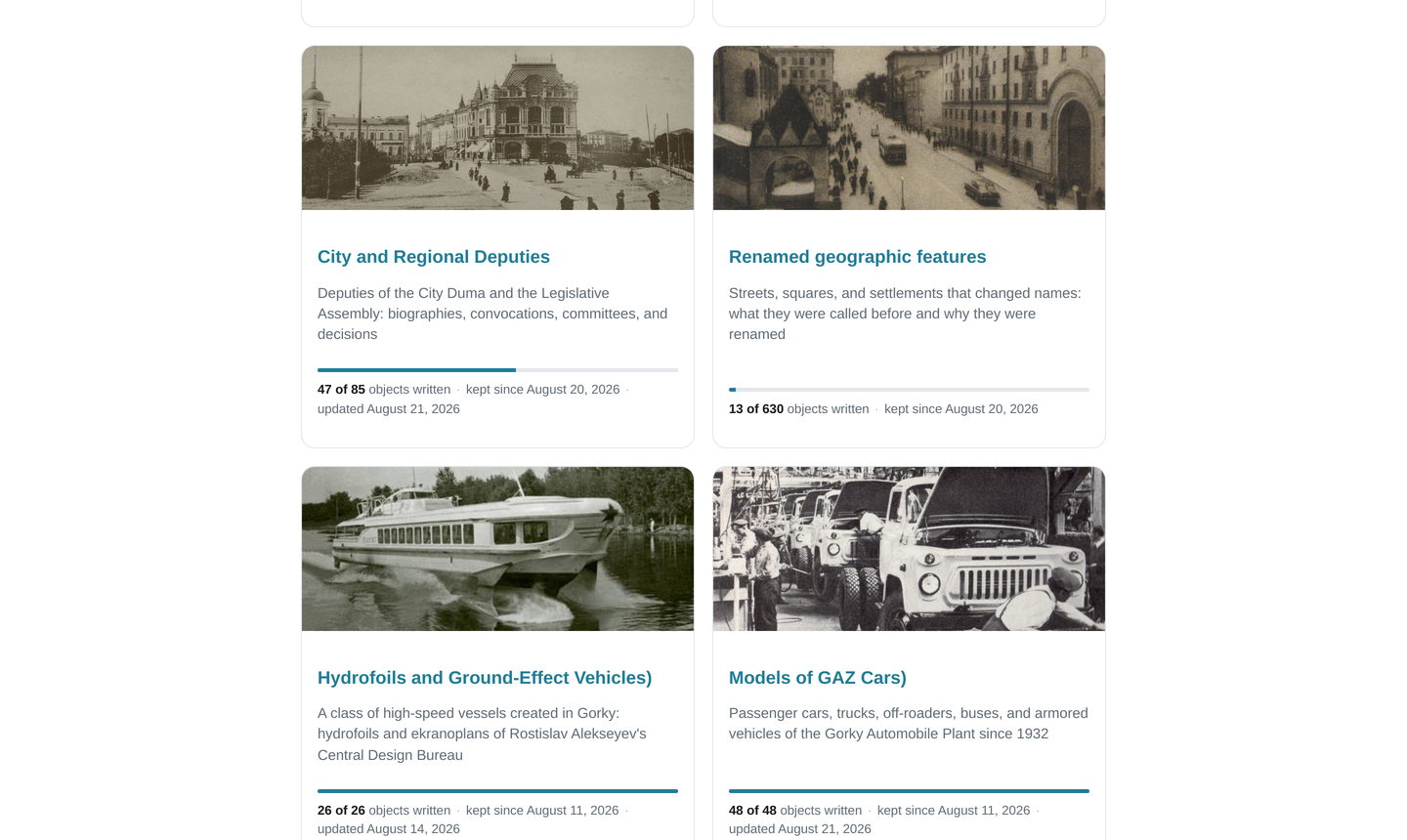
A collection is a complete roster of a class of objects — hydrofoils built in Gorky, models of GAZ cars, renamed streets, deputies, defunct websites. Unlike a category, it lists everything in the class, including what has not been written yet, and shows the count: forty‑eight of forty‑eight means the class is closed, thirteen of six hundred and thirty means the work has barely started. Gaps are not hidden. A blank line in a roster is an invitation.
What it costs
The part that still surprises me is how little all of it consumes. Monitoring, entity markup, writing, the English edition, illustration — properly optimized, the whole machine eats a startlingly small number of tokens, and the bill is a trivial sum. Mechanical steps go to a cheap model; anything a reader will actually read goes to a strong one. Each pipeline runs against its own budget, and when the budget is spent the scheduled job simply skips until the first of the next month. Optimization is the kind of discipline I never managed to keep in a startup, and it is the only reason a one‑person encyclopedia is possible at all.
Beta, honestly
It is in public beta and it shows. Some articles are stubs. Some translations are clumsy. Every week I find a page that has been sitting there wrong for a month. I am not going to pretend otherwise — a project about accuracy that lies about its own state would be a bad joke.
In 2014 I wrote that f‑growth — virality plus retention — is the only honest measure of whether a project is alive. I still believe that. I have just stopped applying it to users. A city has a k‑factor too: every article that gets a second entry makes the next event easier to place, and every entity marked up creates two more places for tomorrow's news to land. An encyclopedia grows by exactly the arithmetic of a social product. It just counts facts instead of people.
www.nnov.ec/en — the English edition. www.nnov.ec — the Russian one.